Music and logistics both live or die by their sequence, but judge it by opposite methods: one by ear, one by cost function. From my habilitation lecture over twenty years ago, I developed two experiments: mathematically analyzing Duke Ellington's "Satin Doll" (matching its statistics perfectly still produces a lifeless tune) and transforming a real container terminal's crane schedule into a playable three-voice score.
The experiment shows similarities between logistical and musical sequencing problems, even though formal correctness and quality are not the same thing in either field. This applies to today's generative AI music tools and AI planning copilots.
I close with four concrete takeaways for logistics practitioners drawn from musical practice: learn from existing patterns, keep human judgment in the evaluation loop, manage the meta-structure across the network, and standardize for real-time decentralized coordination.
In the late 1990s, I sat across from a planner responsible for sequencing the final assembly line of a German car plant. He had been working for six months on new software to optimize the sequence of cars on the final assembly line. The task is not easy — a set of complex sequencing rules like "not 3 combustion engines in a row" needs to be handled. The result of an optimization run was a number, such as 3498, representing the objective function's value and indicating how well all constraints had been met. He looked at it the way you look at a phone number in a language you don't speak. The other result was a picture: a scatter plot showing the list of cars in the assembly line, for which constraints were met, dense in some places, sparse in others. He called it, without a hint of irony, his Sternenhimmel, his heaven of stars.
He didn't optimize the number. He optimized the picture. He'd sit with the tool and nudge the orders around by hand until the stars were evenly spread across the sky. It might be that nudging made 3498 even worse. When I asked him how he judges the quality of the solution, he was very clear: "The workers down at the line give feedback, and the best feedback I get is with a well-distributed heaven of stars." He also talked, the way most experienced planners do, about "good patterns" — sub-sequences he kept in his back pocket and reused, shift after shift, because he'd learned they worked.
The optimization model took years to implement and the planner did not care about the objective function. The quality of the output was the heaven of stars, and only a human eye, trained by years on the floor, could read it.
I am, by day, a Supply Chain Professional and University Professor, and by disposition, a saxophonist. I'd been collecting a version of that same observation from both sides of my life for a long time before I stopped treating it as a coincidence.
The Habilitation Lecture
A few years later, I turned that observation into a formal piece of research, my habilitation lecture at the University of Karlsruhe, titled with more German directness than English elegance: "A Comparison of Musical and Logistical Sequencing Problems." The premise was simple to state and hard to prove. In both music and logistics, the central variable is sequence. An order-picking run, a container terminal's crane schedule, a final-assembly line — the quality of the solution depends entirely on the order in which things happen. A melody makes exactly the same claim: the same seven notes, rearranged, can be a hit or a mess.
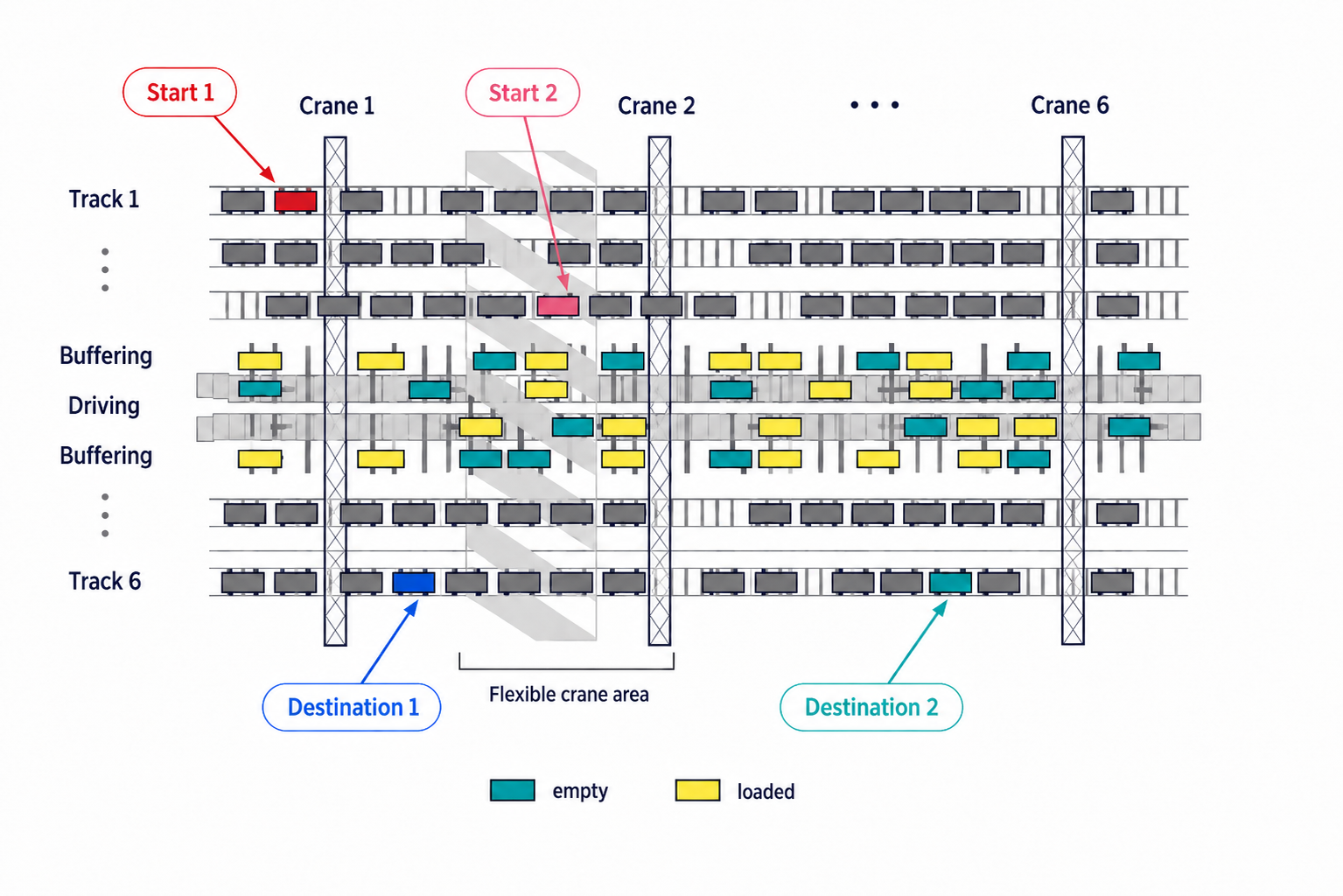
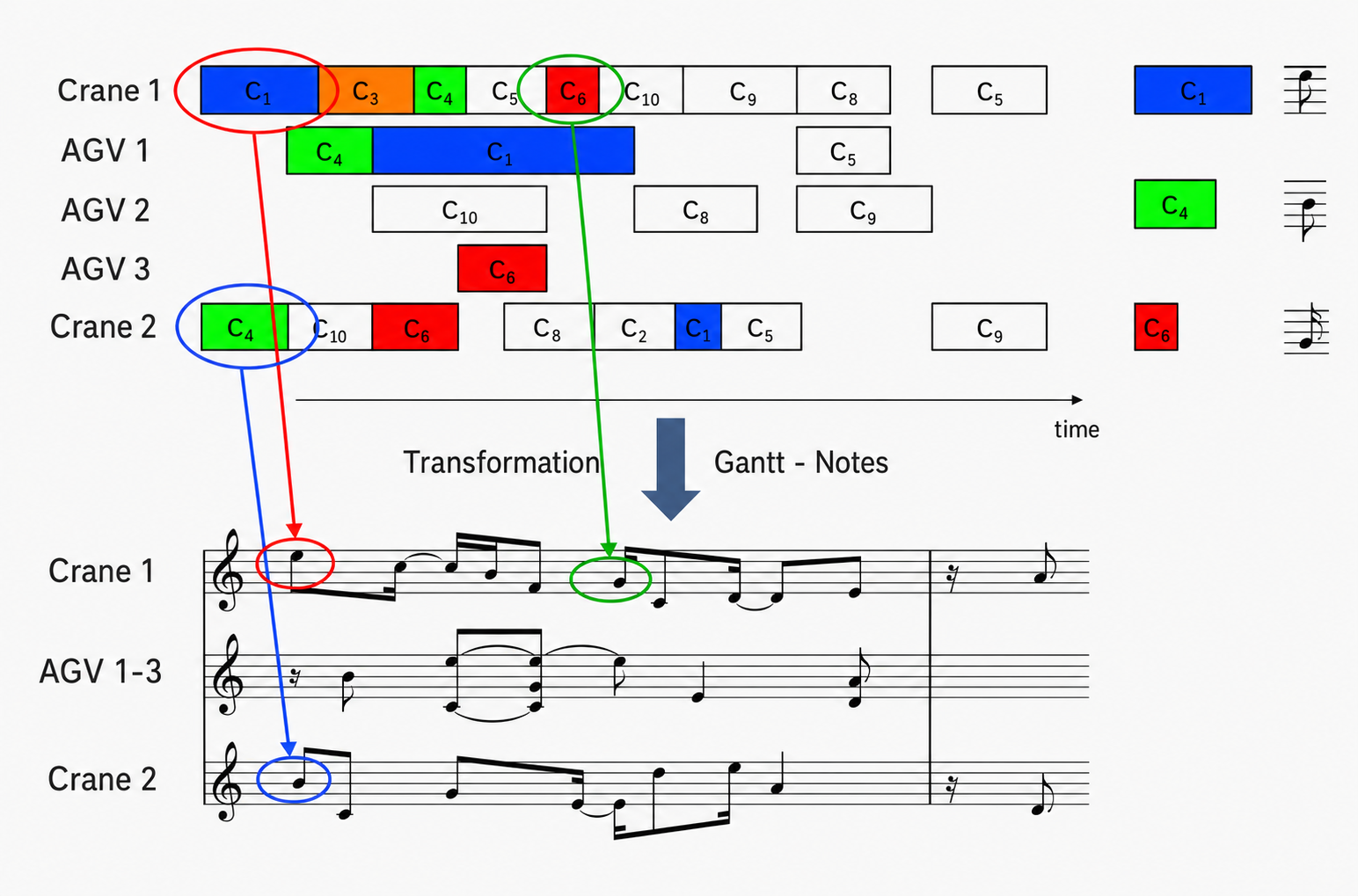
The centerpiece of that lecture, and of the argument that follows here, was a real container terminal (Picture 1), where trains exchange containers the way passengers change platforms. My idea was to represent the sequence of the containers, typically shown as a Gantt chart (Picture 2), as a musical sequence. An idea was born and had to be investigated in more detail. This article is about what I found out — similarities and lessons learned for music and for Logistics & Supply Chain.
How Each Field Builds and Judges a Sequence
Let's get started with logistical sequencing: logistics cleanly splits its sequencing problems into two families.
- Offline problems are those where every order is known before you start calculating and optimizing the sequence — the final-assembly sequence for tomorrow's build plan, the pick sequence for a wave of orders already sitting in the warehouse management system. You have time, so you reach for exact or near-exact methods: branch-and-bound, constraint satisfaction, and metaheuristics like tabu search or genetic algorithms.
- Online problems are the opposite: orders arrive live, the way calls arrive at an elevator bank, and you have to decide now which sequence to execute. This happens with incomplete information, using rules simple enough to execute in milliseconds.
These sequences optimize the objective function (i.e. minimize cost, minimize lateness, maximize utilization) and ensure constraints are met. Often planners call a good solution harmonic, well-designed, and so on.
Music makes the identical split, under different names.
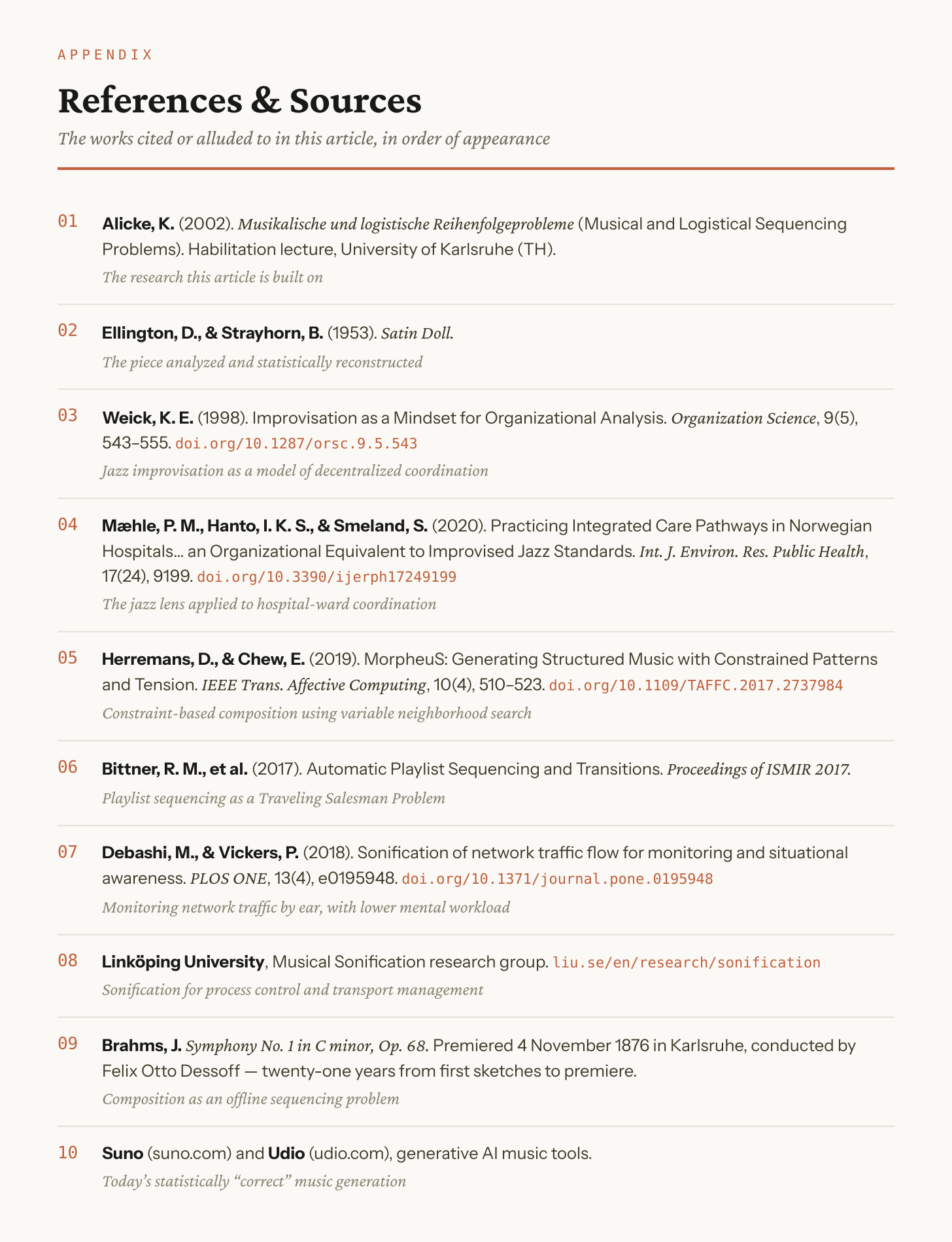
- Composition is an offline problem. Imagine Johann Sebastian Bach sitting alone in a room in front of his piano composing a Cantata, or Duke Ellington composing Satin Doll. They have nearly unlimited time to explore, try out, change the sequence and reevaluate until it matches their expectations. Johannes Brahms took that luxury to its extreme: his First Symphony took twenty-one years from first sketches to premiere, finally performed in 1876 in Karlsruhe. Brahms felt he was composing in Beethoven's shadow and kept discarding what he'd written.
- Improvisation is the online equivalent: a jazz combo trading choruses has no buffer, no chance to undo a phrase once it's played, and has to generate a good sequence of notes in real time. Everyone in the room did agree to the set of rules — chord changes, functional harmony, the twelve-bar or 32-bar form — which are formally constraints in exactly the operations-research sense: they don't tell you what to play, they tell you what you're not allowed to play, and a good improviser searches the remaining space fast.
The evaluation of the musical sequence is done by the audience — did they like what they heard? Do we get standing ovations for our performance?
The online case is interesting. A jazz combo only sounds good when two conditions hold: the basic rules of interaction are standardized across every player, and everyone has real-time information about what everyone else is doing — there is, as the joke goes, no buffer of notes to fall back on. That is precisely the condition a control tower is trying to engineer for a supply chain: standardized rules, shared real-time visibility, decentralized decisions that still add up to something coherent.
Organizational theorists have made almost exactly this argument, independently: Karl Weick's Jazz Improvisation and Organizing, and later work applying the same lens to how hospital wards coordinate care, describe decentralized real-time coordination in language that could be lifted straight into a supply chain textbook. They just never had reason to mention containers.
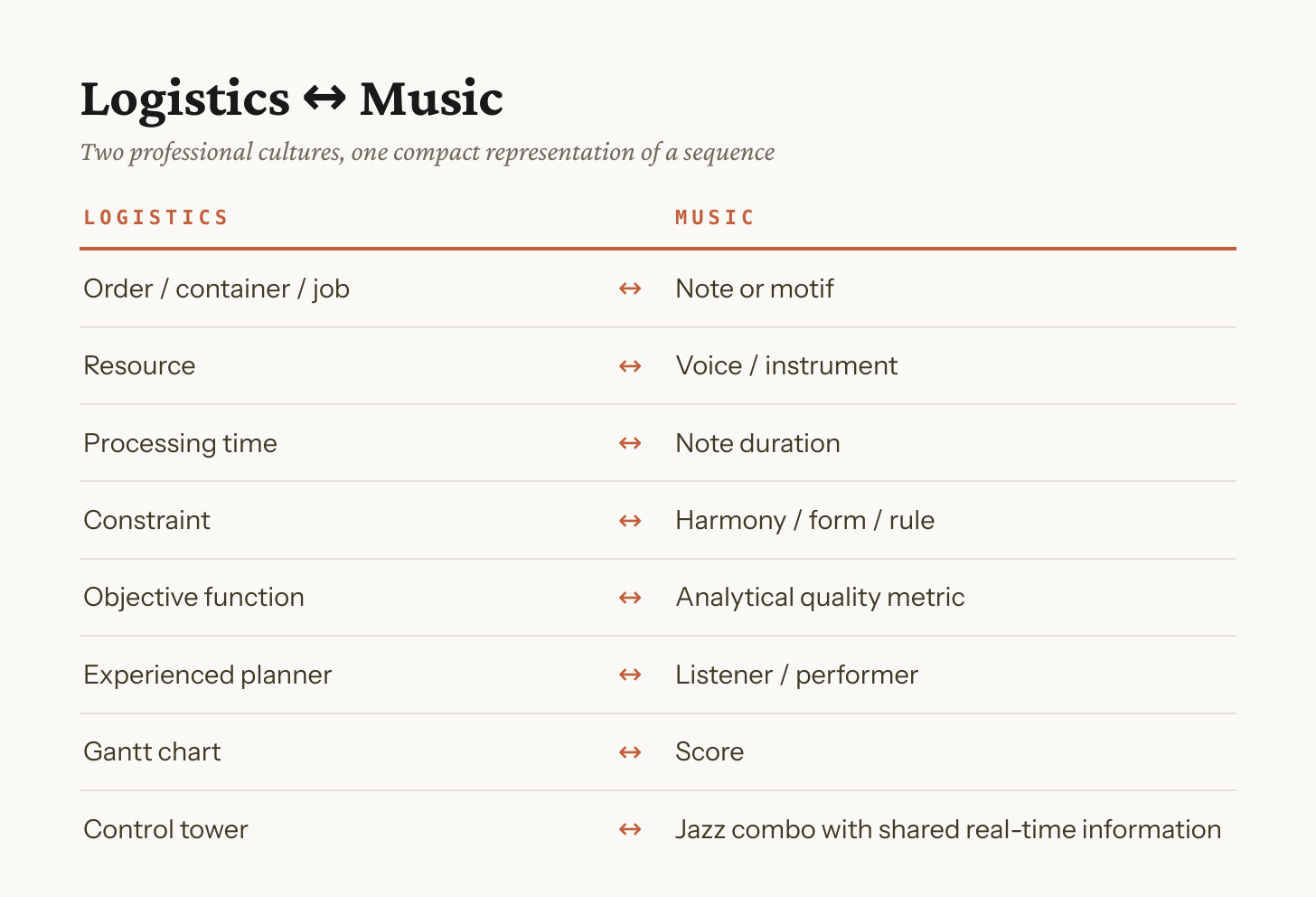
Two professional cultures that never spoke to each other converged independently on the same compact representation of a sequence. A Gantt chart is a score. Time runs left to right, resources are voices stacked vertically, and each block is a note with a pitch (which resource) and a duration (how long it holds). The inventors of staff notation and Henry Gantt were solving surprisingly similar visualization problems centuries apart: how to show events, resources, duration, and timing on a two-dimensional surface.
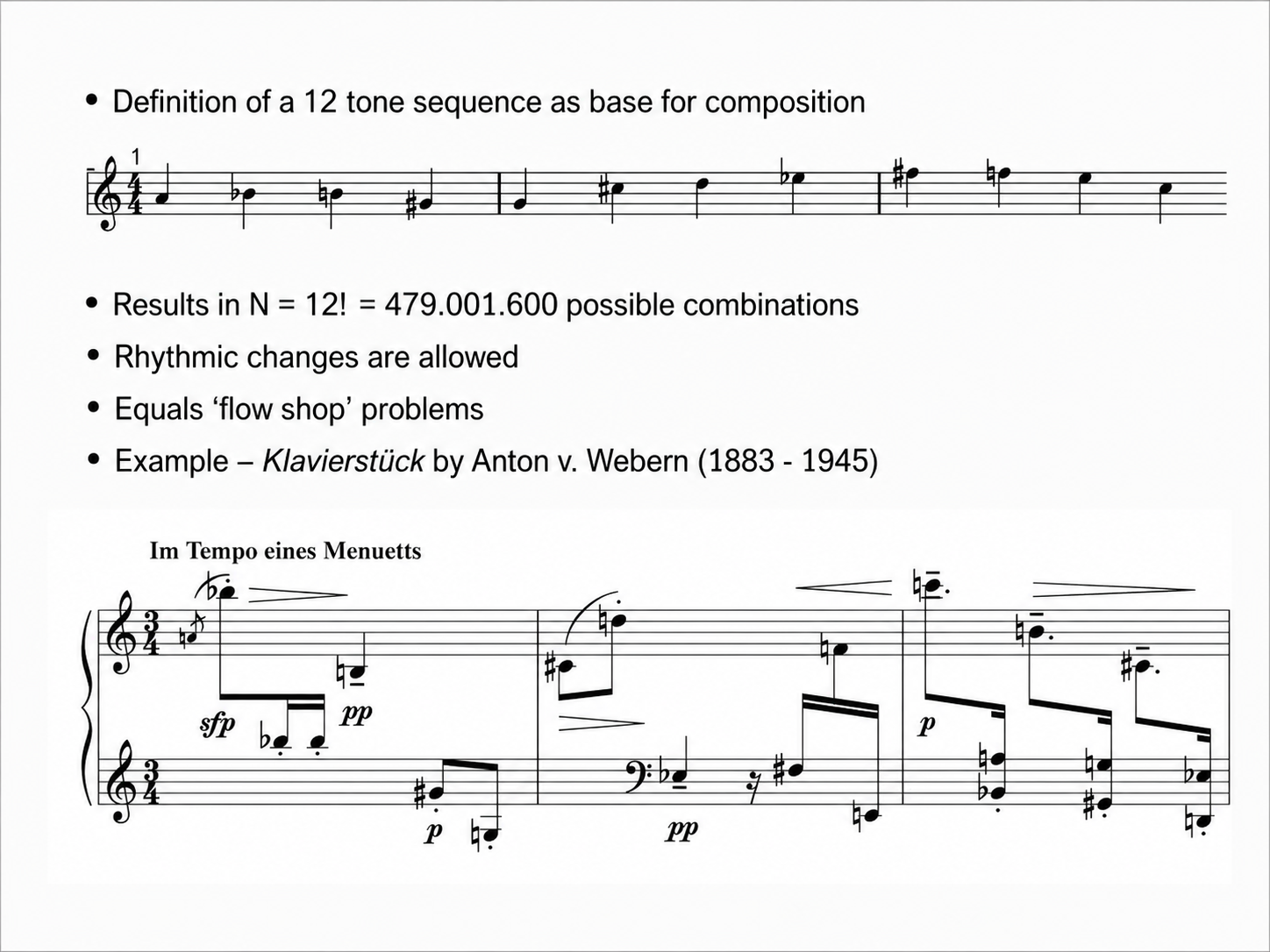
The convergence isn't only historical in one direction. Schoenberg's twelve-tone technique — assigning every note in a row so that all twelve chromatic pitches sound once before any repeats — is, formally, a permutation problem: twelve elements, 12! ways to order them, which comes out to 479,001,600 possible rows. In production planning, this is the well-known flow-shop scheduling problem with twelve jobs on one machine (Picture 3).
And today's playlist apps already do something similar: they sequence songs by solving a variant of the Traveling Salesman Problem, keeping similar-sounding tracks next to each other.
The Experiment to Understand Algorithmic Composition: Satin Doll Turned Inside Out
I wanted to test whether any of this was more than an appealing parallel, and the only honest way to do so was to pick a piece of music people already loved and try to rebuild it algorithmically. I chose "Satin Doll," Duke Ellington and Billy Strayhorn's 1953 jazz standard.
Listen while you read: Satin Doll — Duke Ellington, on Spotify.
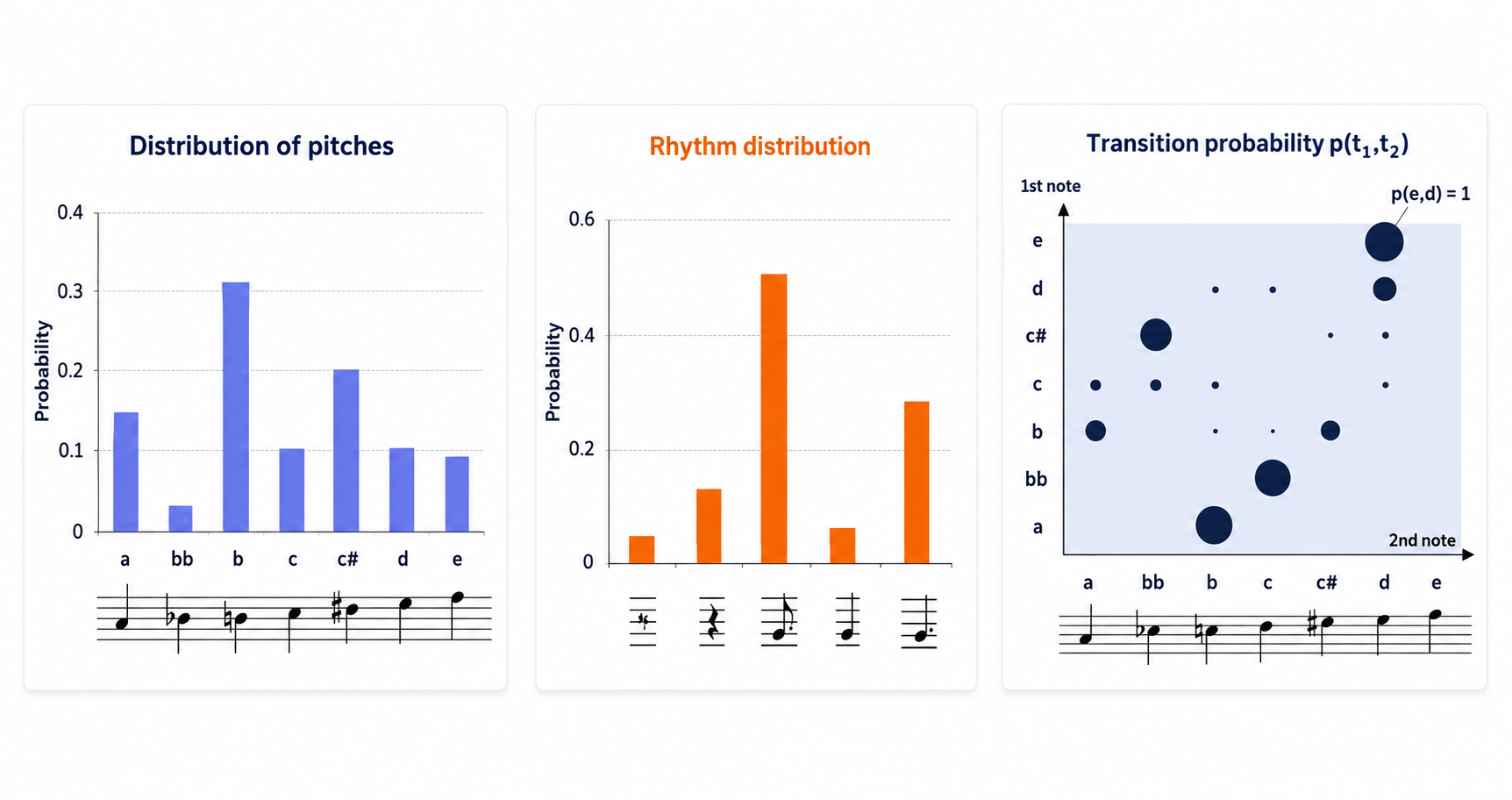
The theme uses seven distinct pitches and five rhythmic values. I ran the actual analysis in a very analytical approach, as you would expect from a Supply Chain Professional: the distribution of which notes occur and how often, the distribution of note durations, and — because a melody is also a sequence with transitions — the Markov chain of which note follows which. The note e is followed by d with probability 1, no exceptions. Picture 4 shows the analysis.
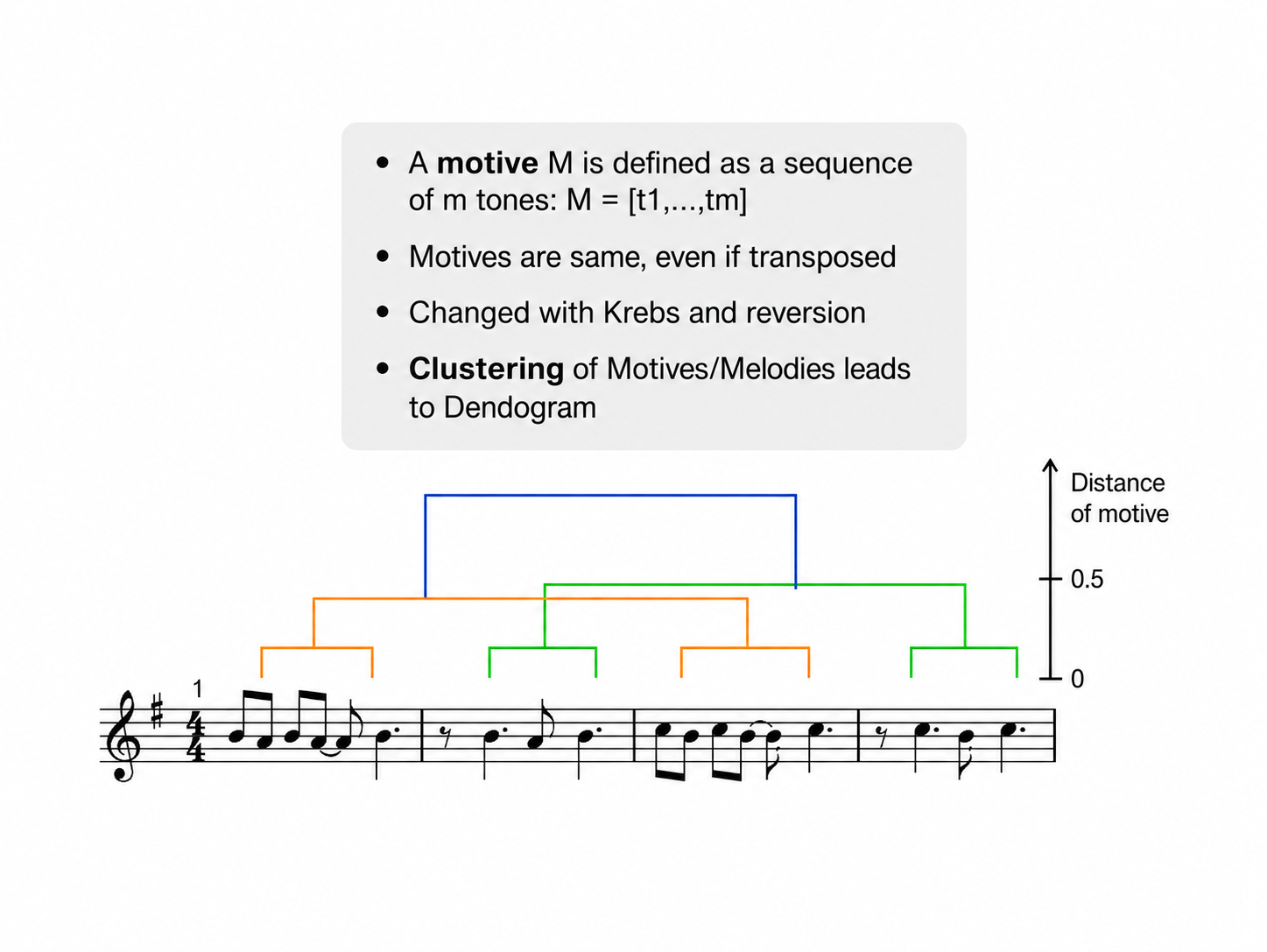
Then I went even deeper and examined the melody's patterns to understand the meta-structure. A motive is just a short sequence of tones, and motives cluster: transpose one, invert it, run it backward, and it's recognizably the same idea wearing a different hat. Cluster the motives across the whole theme, and you get a so-called dendrogram — the same tool a distribution center uses to group articles into families, applied to two-bar phrases instead of SKUs. The analysis is shown in Picture 5.
I built a new melody using exactly the same note distribution, exactly the same rhythm distribution, and exactly the same transition probabilities as Satin Doll. Statistically, it was indistinguishable from the original. It sounded terrible — mechanical, arbitrary, dead on arrival. Matching every number the analysis could produce was not the same as writing a tune anyone would want to hear twice.
Formal correctness and quality are not the same thing. That's where the beauty lives — in the deviation, not the compliance.
This isn't only my finding, either. Twenty years on, constraint-based composition systems — Dorien Herremans and Elaine Chew's MorpheuS, for instance, which generates music using variable neighborhood search, the identical metaheuristic family logistics uses for vehicle routing — run into the same wall, and spend most of their computational effort on exactly the layer hardest to formalize: tension, pattern, the sense of a shape unfolding rather than a histogram being satisfied. Even Bach's own fugues, the most rule-bound music ever written, don't always obey the rules he set down for everyone else. That's not a flaw in the analysis. That's where the beauty lives — in the deviation, not the compliance.
This is the planner's heaven of stars again, found on the music side. The algorithm can match every statistic in sight and still miss the thing an ear catches in half a second. So I went looking for the same gap from the opposite direction: instead of generating music from statistics, what happens if you take a sequence that's already real, already optimized, and transform it directly into notation?
The Megahub: Turning a Container Terminal Into a Musical Score
The transformation rule, once I'd settled on one, was almost embarrassingly simple. Take the Gantt diagram of a real container terminal's handling sequence — the rail-to-rail hub from the habilitation lecture, cranes lifting containers between train sets, and AGVs connecting crane areas. Assign every container a tone. Let the duration of its handling operation set the note's length, rounded to the nearest sixteenth. Assign an instrument to each resource: crane 1 becomes a flute, crane 2 a double bass, the buffer where containers wait to be re-sorted becomes a polyphonic piano. Run the whole sequence through and you get a genuine three-voice piece of music — not a metaphor, not a sonification gimmick, but a score a working musician could sit down and play.
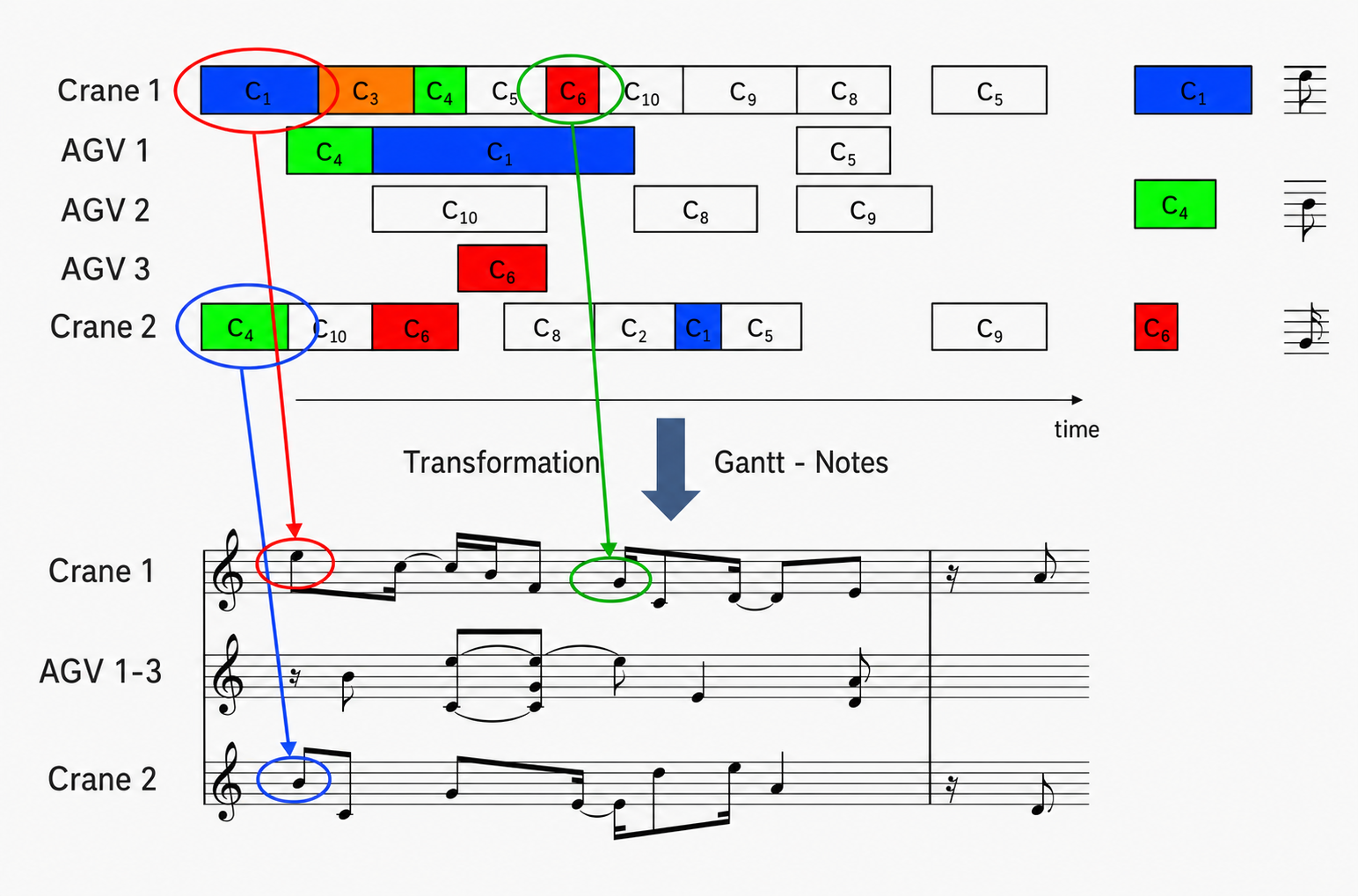
Listen to it and you'll hear what I heard the first time: it doesn't sound like a tune. It sounds closer to Sphärenmusik, music of the spheres. It is structurally coherent, genuinely playable by three musicians in a room, and aesthetically orphaned because nothing in the transformation rule is anchored to a major or minor key. There's no reason it should resolve the way a Western ear expects resolution, because I never told it to. It's the mirror image of the failed Satin Doll reconstruction: there, matching the statistics wasn't enough to make good music; here, a genuinely well-optimized logistics sequence, transformed faithfully, produces something structurally sound but harmonically homeless.
I never fully answered the question I raised at the time, and I'll leave it open here rather than pretend otherwise: what would the back-transformation look like? If you took a piece of music built this way and read it again as a container sequence, assigning tones back to containers and note lengths back to handling times — how good would that sequence actually be, by logistics' own cost measures? I don't know. It's a genuinely unresolved thread from work I did over twenty years ago, and it still strikes me as the more interesting half of the experiment.
Put the two experiments side by side and they triangulate the same wall from opposite directions.
- Analysis first: understanding what makes a good tune, mathematically, and discovering the math doesn't reproduce the tune.
- Application second: taking something already good by a different discipline's standard and translating it faithfully, and discovering translation doesn't guarantee beauty either. Same finding, both directions, twenty years and one saxophone apart.
What Can Logistics Sequencing Learn From Musical Sequencing?
Learning is based on existing material and pieces. Composers absorb hundreds of standards before writing their own, much like an experienced demand planner who absorbs years of sales history before building and trusting a forecast. Neither discipline actually starts from zero, whatever the optimization model likes to assume.
Personal impression and aesthetics matter — the heaven of stars again. A sequence can score well on paper and still feel wrong to the person who has to live inside it, and that feeling is data, not noise. Satin Doll's transition probabilities didn't produce a good tune; a listener's ear did the real evaluation. The lesson for logistics is clear: build the objective function, but don't let it be the only judge. Keep the experienced planner's veto.
Meta-structure needs to be considered to create tension. A good four-bar phrase can still make a forgettable tune if the piece has no arc. A well-sequenced pick wave can still result in a mediocre supply chain if nobody manages the shape of the entire network. This is already happening: just-in-sequence delivery in automotive has stretched from the assembly line back through the first-tier supplier, because a locally perfect sequence that ignores its neighbors stops being locally perfect for very long.
The basic setup and rules of interaction need to be standardized. A combo needs a shared harmonic language before anyone can improvise well together; a network needs shared master data and shared rules before anyone can plan well together. And all information needs to be available in real time — there is no buffer of notes to fall back on. This is exactly why a control tower that reports last week's exceptions is not actually decentralized control. It's just delayed centralized control with better graphics.
None of these four lessons required new mathematics to discover. They required treating two centuries of accumulated judgment about what makes a sequence good — in a discipline that happens to write it down as notes rather than purchase orders — as data worth taking seriously.
Twenty-Two Years Later — Same Paradox, Higher Stakes
Suno and Udio can now generate a song that is, by every statistical measure a model can check, "correct" — right key, right chord progression, right instrumentation for the genre tag you typed in. It is the Monte Carlo Satin Doll reconstruction again, at industrial scale, available to anyone with a text box. And it runs into the identical wall: technically fluent, and something in it is usually just slightly off, the way the statistically perfect melody was off, because correctness was never the thing that was missing.
The same pattern is showing up, right now, in supply chain planning. Advanced Planning Systems (APS) can propose a "statistically optimal" production schedule or replenishment plan in seconds, built from constraint satisfaction, metaheuristics, mathematical optimization algorithms, and so on. In theory, that should settle the question; the algorithm has more data and more compute than any human planner ever will. In practice, experienced planners still regularly override these recommendations, and they are frequently right to do so — not because the algorithm made an arithmetic error, but because it doesn't have the thing the automotive planner had, sitting there in front of his heaven of stars: a felt sense, built from years of watching sequences succeed and fail on the actual shop floor, for the layer the objective function never captured.
I don't think that's a temporary gap that better models will close next year. It's the same gap in both fields, wearing different clothes — between what a model can formalize and what a practitioner's ear, or a planner's feel for a good pattern, has learned that the model hasn't yet been taught to ask about.
The Heaven of Stars, Updated
Twenty-some years ago, around the same time as the habilitation lecture, I speculated about something further out: a control tower you could listen to, rather than only watch. Ordinary flow rendered as something harmonic. Congestion slowing the tempo into a ritardando. An accident landing as a sudden fortissimo. At the time it was a thought experiment, mostly there to make a point about how much information a sequence already carries in its shape, if you're willing to hear it instead of only reading it off a dashboard.
You just heard a small, real piece of that vision. A working container terminal sequence, played by a flute, a double bass, and a piano, exactly as the cranes moved. It was buildable in 2002 with enough patience and a MIDI synthesizer.
With today's generative audio models, doing it live, across an entire operation, updating in real time, is no longer a thought experiment. Sonification is a real, active research field. Linköping University runs a group on exactly this — for process control and transport management, among other things — and a 2018 study already found network operators monitoring traffic by ear caught anomalies with less mental effort than watching a screen. Logistics flow is a short step from network traffic.
So here's the question I'd actually like an answer to: would you want to hear it, before you'd want to see it? I know which one the automotive planner would have picked.
Appendix