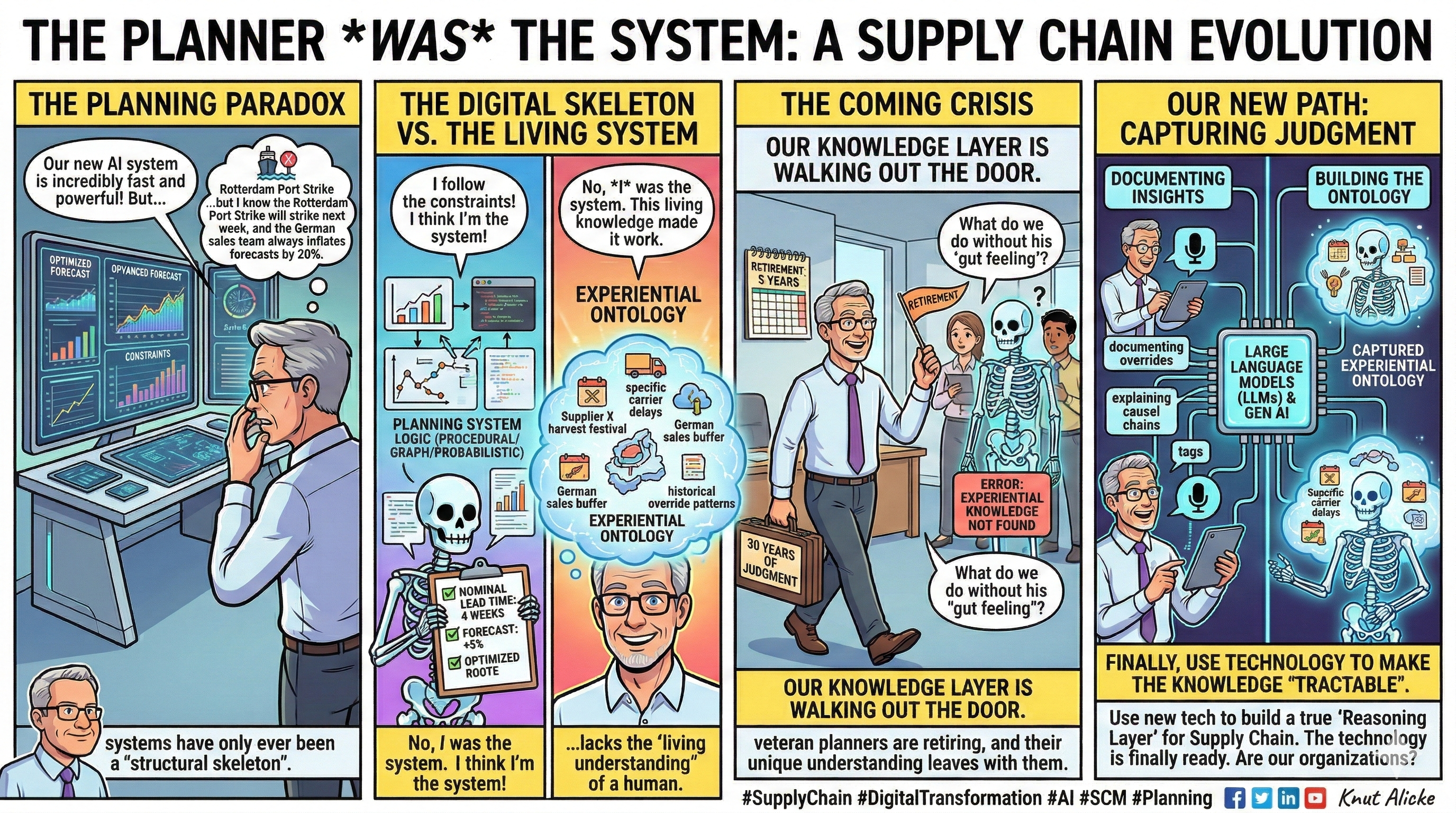
The Paradox
Here is something that should bother every supply chain executive, but rarely gets stated plainly.
We have spent thirty years and tens of billions of dollars building advanced planning systems. The technology is genuinely impressive — constraint-based optimization solvers, multi-echelon inventory models, statistical forecasting engines, scenario planning architectures. In theory, these systems should produce better supply chain decisions than any human could construct manually. They have access to more data, they can process more variables simultaneously, they never get tired, and they don't have political relationships with the sales team that distort their judgment.
In practice, experienced planners routinely override them. And they are often right to do so.
This is the central paradox of supply chain planning, and it has been sitting in plain sight for three decades. Every implementation I have been part of, every planning transformation I have observed, eventually arrives at the same moment: the system produces a recommendation, the experienced planner looks at it, and something in their expression says: that's not right, I expected something different. They change the number. They move on. The system logs the override, learns nothing, and produces the same type of wrong recommendation next month. And the planner's judgment is often correct, sometimes wrong.
Why does this happen? The usual answers are unsatisfying. Poor data quality. Insufficient user adoption. Change management failures. Inadequate training. These explanations are not wrong, but they are superficial. They treat the symptom — planners not trusting the system — without asking why the system consistently produces recommendations that experienced planners find untrustworthy.
Planning systems have never had a complete knowledge model of the supply chain they were supposed to be planning. They have been given a structural skeleton and asked to make decisions that require a living, experience-rich understanding of how the supply chain actually behaves. The skeleton is not enough. So the experienced planner — carrying that living understanding in their head — has been quietly doing the reasoning work that the system was supposed to do. For thirty years.
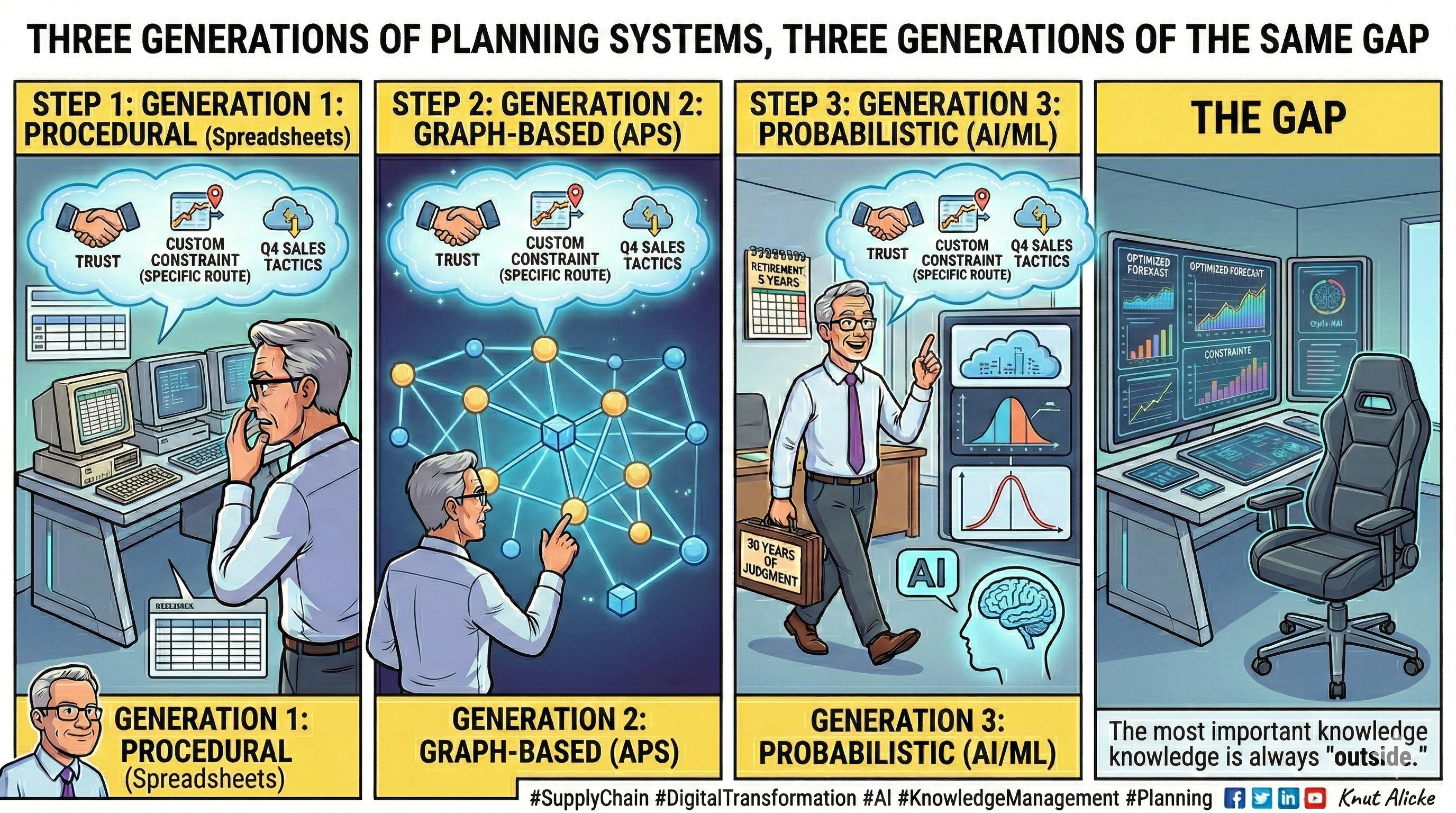
Three Generations of Planning Systems, Three Generations of the Same Gap
To understand where we are, it helps to understand how planning systems have evolved — and, more importantly, what has remained constant across every generation.
Across all three generations, the same gap persists: the behavioral knowledge — the experiential understanding of how the supply chain actually works in practice — lives in people's heads, not in systems. The generations have gotten better at the structural and statistical dimensions of the knowledge model. None of them has touched the experiential dimension.
The Planner Was the Ontology
Let me introduce a word that deserves more use in supply chain conversations: ontology.
In philosophy, an ontology is simply an account of what exists — a formal specification of the entities, properties, and relationships that constitute a domain of knowledge. In computer science and artificial intelligence, it has a more specific meaning: a structured representation of knowledge in a domain that enables reasoning, not just retrieval.
"A database tells you facts. An ontology tells you what those facts mean and what you can infer from them."
Now consider what a supply chain ontology would actually need to contain to enable the kind of reasoning that experienced planners do routinely. It needs to know that "supplier reliability" is a meaningful concept with multiple dimensions: on-time delivery rate, quality acceptance rate, flexibility under expedite requests, communication responsiveness — and how these dimensions vary by season, by order volume, and by the state of the relationship.
None of this is in any planning system. But here is the critical observation: in organizations with experienced planners, this ontological reasoning is happening. It is just happening inside human heads rather than inside systems.
When an experienced planner opens the stock and requirements screen and scans through the exception list, they are not simply reading data. They are applying a rich contextual model — filtering signal from noise based on a mental model of how the system tends to behave, recognizing patterns that indicate real problems versus system artifacts, mentally adjusting for known data quality issues.
This is ontological reasoning. The planner is the ontology. And this is not a metaphor — it is a precise description of the computational function the planner is performing.
The cost of this arrangement is enormous and almost never counted. It means that the supply chain's reasoning capacity is limited by planner attention — scarce, expensive, and non-scalable. And it means that when a planner leaves, the ontology walks out the door with them.
The Retiring Knowledge
They have been with the company for twenty-five or thirty years. In that time, they have built an internal network that is, frankly, remarkable — they know the right person to call in every function and every plant, they know who actually makes things happen versus who merely appears to, and they have a track record of getting answers and solutions in hours that would take anyone else days.
This planner is the single most important node in your supply chain planning process. Your organization almost certainly does not know this, because the most important nodes rarely appear in organizational charts or digital transformation roadmaps. They appear in crisis — when something goes seriously wrong and everyone instinctively picks up the phone and calls the same person.
And they are probably retiring within five years.
What will leave with them is not documented anywhere. They know that Supplier X's quality drops measurably in Q4 — not because of any formal quality record, but because they personally noticed the pattern over multiple years. They know that a specific supplier always shuts down for three weeks in August, not the two weeks officially announced — because the production workers take individual vacation in the surrounding weeks and output drops to near zero even when the factory is nominally open. They know this because they were caught out by it once, early in their career, and never forgot it.
The organizational theorist Michael Polanyi described it with a phrase that has stayed with me: "we know more than we can tell."
The uncomfortable truth is that tacit knowledge of this kind — the behavioral, experiential understanding of how a specific supply chain actually works — is the primary determinant of planning performance in most organizations. Not the sophistication of the planning system. Not the optimization algorithm. Not the data warehouse. The human being sitting in front of the screen, applying thirty years of accumulated understanding to interpret what the system is telling them.
And organizations have no systematic way to capture it, no mechanism to transfer it, and no plan for what happens when it retires.
The 5-Why Test
There is a diagnostic technique that reveals, more clearly than any other, the full depth of what experiential knowledge actually requires. The technique is called 5-Why. You observe a problem and ask "why" repeatedly — typically five times — until you reach a cause that is both genuinely causal and actionable.
The technique sounds simple. In practice it is extraordinarily demanding, because it requires the person conducting it to have sufficient domain knowledge to recognize at every step whether an answer is genuinely causal or merely a plausible-sounding intermediate explanation that will mislead the investigation.
The situation: excess inventory has been building in a European distribution center for three months.
- We ordered too much.
- The system generated high replenishment recommendations.
- The safety stock parameter was set high.
- It was configured that way during implementation.
- Unknown — predates the current team.
- Replenishment orders were consistently higher than customer orders.
- The demand forecast was consistently 20–25% too high.
- The commercial team's S&OP input was inflated.
- They experienced an allocation cut in Q3 and have been protecting their position since.
- Safety stock didn't account for Q4 lead time variance from the primary supplier — causing the stockout.
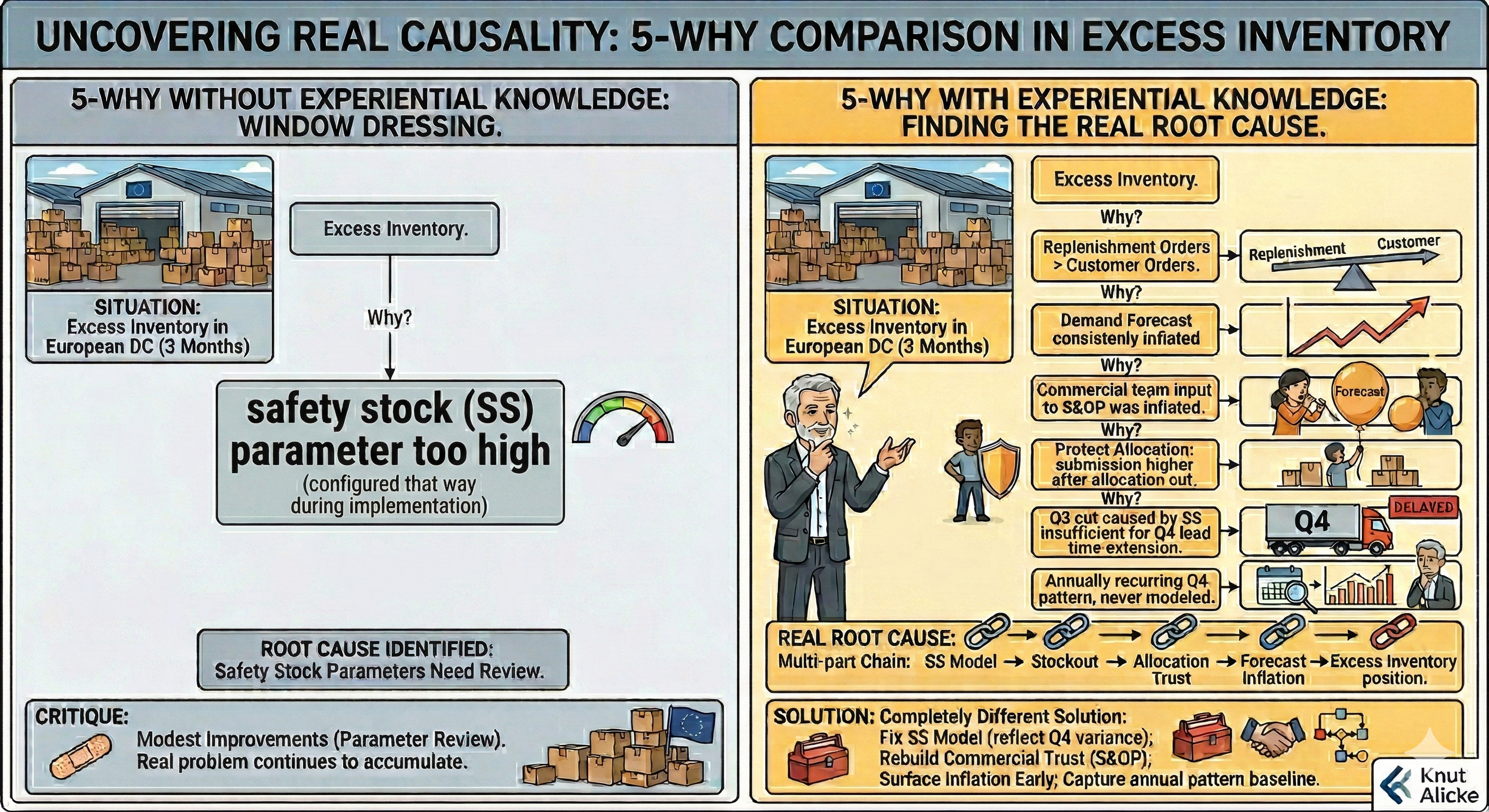
The difference between the two chains is entirely explained by experiential knowledge at each step. None of this is in any planning system. All of it lives in the head of an experienced planner who has been paying attention.
The 5-Why technique also reveals that genuine root cause analysis requires four distinct types of knowledge that go well beyond anything current planning systems encode: causal depth, episodic memory, organizational behavior modeling, and cross-domain reasoning. Each of these connections crosses a domain boundary that no single planning module was designed to span.
The Experiential Ontology
We now have enough ground prepared to name the concept precisely. Current planning systems have something approaching a structural ontology: they model the entities of the supply chain domain and the formal relationships between them. What they entirely lack is what I want to call an experiential ontology: a knowledge layer that captures not what is formally true about the supply chain, but what has been learned to be behaviorally true through observation, experience, and organizational memory.
Let me make the distinction concrete with three examples.
Supplier lead time
Supplier X has a lead time of four weeks. This is a formal property, entered at configuration time, nominally accurate.
Supplier X has a nominal lead time of four weeks and a behavioral lead time that varies from two to eight weeks, with a reliable pattern of six-week lead times in Q4 due to factory capacity constraints during the harvest period. Known only to planners who have managed this supplier over multiple Q4 cycles.
Forecast bias
Demand forecasts are submitted by the commercial team via the S&OP process on the 10th of each month.
Demand forecasts from the German commercial team have a systematic positive bias of approximately 20% in the first submission. This bias emerged following an allocation event in Q3 three years ago and represents rational defensive behavior given the team's incentive structure.
Safety stock logic
On-hand inventory is declining towards the safety stock level. The system shows no alert — the situation is within planned parameters.
In week five of a six-week sea freight transit, approaching safety stock is normal system behavior, not a crisis signal. A planner without deep experience will panic, place an expensive air freight order, and watch both shipments arrive simultaneously four days later. The experienced planner reads the pipeline, not just the on-hand level.
The experiential ontology does not compete with the planning system. It completes it.
GenAI as the New Associate
Here is where the technology connection becomes precise — and where I want to be careful not to overclaim, because the supply chain technology space has a long history of overclaiming.
GenAI does not automatically build an experiential ontology. It is not magic. But it provides, for the first time, a set of capabilities that make building an experiential ontology tractable in a way that was previously impossible: the ability to engage in natural language conversation, to reason over complex and contextually rich information, to ask clarifying questions intelligently, and to learn from interaction over time.
The metaphor I keep returning to is the new associate joining the planning team. A good new associate doesn't walk in on day one and start making decisions. They observe. They ask questions. They try to understand not just what decisions are being made, but why.
The practical foundation is to leverage the moments when experiential knowledge is actually applied — around overrides and exceptions. Every time a planner overrides a safety stock recommendation or manually adjusts a forecast, they are applying experiential knowledge. The current system logs the change and discards the reasoning entirely. The new associate approach captures the reasoning.
Not through a form or a mandatory comment field — those produce noise, not knowledge. Through a brief, natural conversation. "You increased the safety stock for this material by 40% — is this driven by a supplier concern, a forecast uncertainty, or something else you're seeing?" The planner's answer gets captured, interpreted, and stored as a structured knowledge element.
Every interaction must feel like value exchange, not data extraction. Planners will engage if and only if the new associate is visibly useful — if it gives back more than it asks for. Immediately. Not eventually. The moment the interaction feels like filling in a form, engagement collapses and the knowledge capture fails.
Training the Next Cohort of Experienced Planners
How do we enable our younger colleagues to develop the experiential knowledge of planners? I don't believe AI will kill all entry-level jobs. There is a big misperception — AI might help execute the entry-level tasks, but the real learning for new joiners is feeling the business, building networks of colleagues, and understanding the product.
The full range of supply chain judgment — the ability to run a genuine 5-Why to the real root cause, to recognize which exceptions matter, to read organizational dynamics in an S&OP meeting — this cannot be extracted from a board game or lecture slides, however well-designed.
Consequence-compressed learning
We need to design educational experiences where the learner feels the real cognitive and emotional weight of consequential decisions and their downstream outcomes, in compressed time, with enough repetition to begin building genuine pattern recognition.
Traditional case studies fail not because they lack intellectual content, but because the learner knows they are case studies. There is no skin in the game. Consequence-compressed learning changes this: if a team over-commits to a supplier in week two of a simulation, they spend weeks four and five managing the inventory excess that decision created — alongside a new disruption that was always coming but that they did not have time to anticipate because they were managing the mess from week two.
The AI tutor as accelerant
An AI tutor built on a rich experiential ontology — trained on the reasoning of hundreds of experienced planners across thousands of supply chain situations — can provide the debrief function at scale. Not the same as a human mentor. But capable of providing the frequency of meaningful feedback that human mentorship cannot match.
Two hundred scenario cycles in a year, each with a thoughtful debrief, is not equivalent to fifteen years of operational experience. But it may compress the learning curve in a way that nothing else currently available can.
Getting Started Without Waiting for Perfect Data
In a lot of discussions with operational leaders, I hear the same thing: we first need to fix our data issues, and only then can we build a modern semantic knowledge layer. The story has not changed in thirty years, because MDM is one of the least sexy topics in the world and no one wants to own it. But it is also the most important one.
The most valuable experiential knowledge that experienced planners carry is often knowledge about the data's limitations. These are facts about the gap between the structural ontology and reality — the metadata about data quality — and this is exactly the information you need to run a targeted, prioritized data quality program rather than a generic "clean everything" MDM effort.
The practical implication is that the work does not have to be sequential. It can be organized as three parallel streams that converge over time.
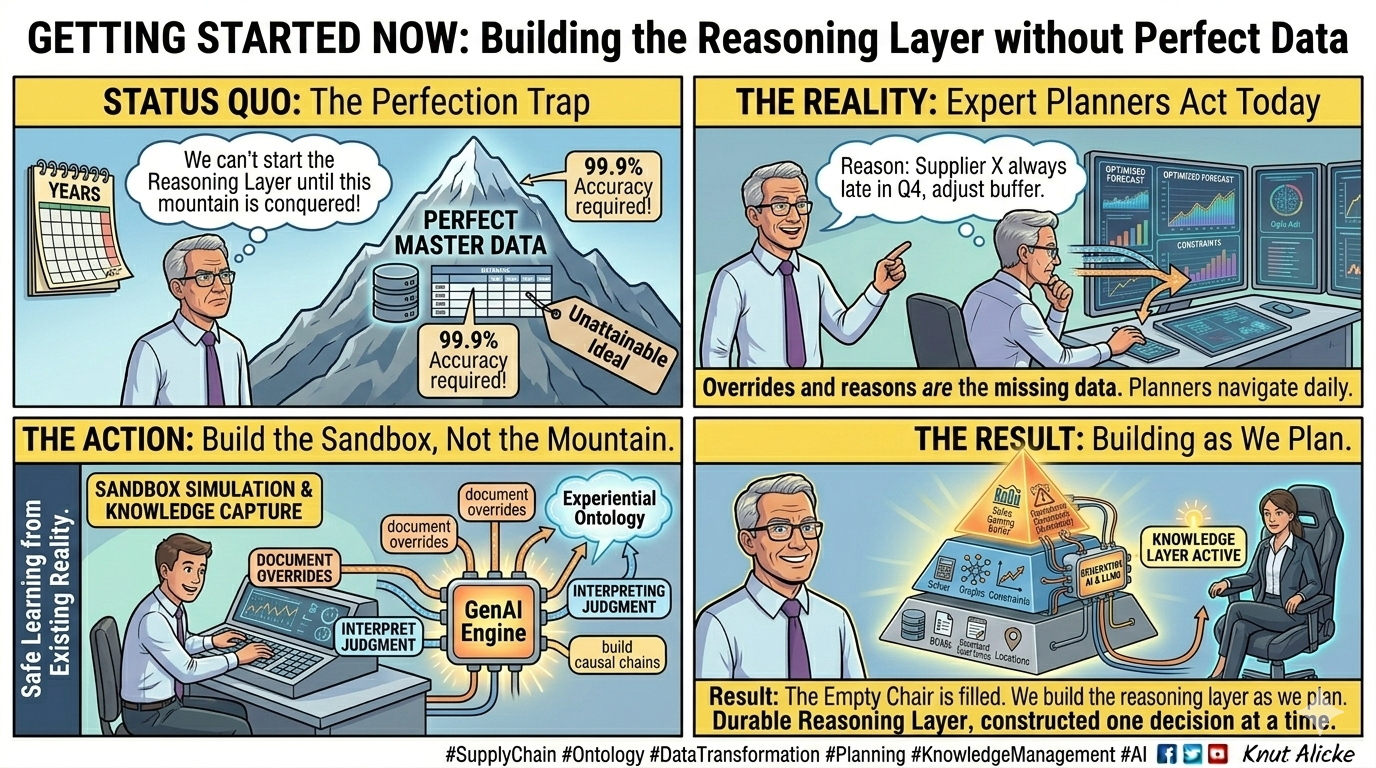
One important design requirement: captured knowledge will contain two distinct types that need to be tagged separately. Genuine experiential knowledge — behavioral insights that would remain true even with perfect structural data — versus compensating knowledge — workarounds that exist because of known data quality problems. When the data gets fixed, compensating knowledge becomes actively harmful. Distinguish them from the start.
The Closing Provocation
Let me return, at the end, to where I started.
Why have experienced planners been routinely overriding sophisticated planning systems — and often been right to do so — for thirty years?
Because the systems were given a structural skeleton and asked to make decisions that require an experiential understanding of how the supply chain actually behaves. The experienced planner filled that gap. With their attention, their memory, their judgment, their relationships, their cognitive capacity. They have been the ontological layer their planning systems never had. And they have been doing this work invisibly, without recognition, at enormous personal cost, for three decades.
This arrangement has reached its natural endpoint for two reasons converging simultaneously. The first is demographic: the generation of planners who have been carrying this knowledge is retiring. The second is technological: for the first time, we can capture experiential knowledge at scale — through GenAI-powered conversation interfaces that can engage planners in natural language, learn from their reasoning, and build a persistent, structured, reasoned knowledge base from their expertise.
The supply chains that build experiential ontologies now will have a compounding advantage that cannot be replicated quickly. Not because they deployed the best technology. Because they finally captured the best knowledge.
That knowledge is sitting in your planning team right now, in the head of someone who is probably not in any leadership presentation, who has probably been in the same role for fifteen years, and who is probably thinking about retirement.
Before they leave, ask them why.